How the 2026 primaries are reshaping the Democratic Party
The struggle over control of the Democratic Party’s direction has roared to new heights this year, with New York’s primary on Tuesday looming as the next major battlefield between left and center.
From Maine to California, progressive and centrist forces have collided in an unusual, even unprecedented, number of primaries for local, state and congressional offices that have divided the party along ideological, and often generational, lines.
“The formal party structure is getting weaker and outside groups are getting stronger,” said Liam Kerr, co-founder of Welcome, a group working to support Democratic centrists, in a judgment echoed by many progressive activists. “We have not been in a place (before) where entire ecosystems of groups are effectively running parties within the parties in explicit, direct, factional warfare.”
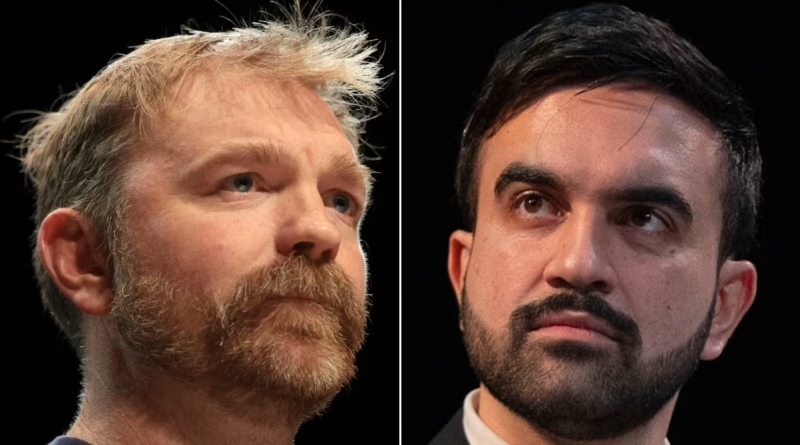
These confrontations have not produced a knockout victory for either side. The left has helped propel Graham Platner to the Senate nomination in Maine and Zohran Mamdani to the mayoralty in New York City, while centrists have cheered the primary successes of Xavier Becerra in the California governor’s race and Josh Turek in Iowa’s Senate contest.

On balance, though, the left so far has outpointed the center in these contests — an advantage it could widen if several Mamdani-endorsed congressional candidates win in New York, as is expected. “This has been a banner year for progressive candidates and the progressive movement,” said Joseph Geevarghese, executive director of Our Revolution, the political organization founded by Sen. Bernie Sanders. “We’re seeing a lot of grassroots electoral energy.”
In many ways, the left’s success this year replays that of President Donald Trump’s first term, when frustration over the Democratic congressional leadership’s inability to more effectively resist him powered the 2018 victories of Rep. Alexandria Ocasio-Cortez and the other three members of the left-wing “Squad.”
“When President Trump is actually in office and Democratic voters are more frustrated with their party’s capabilities to block him, they go even further in the direction of the left,” said David Wasserman, senior political analyst for the Cook Political Report with Amy Walter. “It’s not coincidental that 2018 was the initial burst of the Squad and now we are seeing an expansion of it, to a degree we didn’t in the intervening years.”
But Democratic centrists correctly point out that a significant majority of the successful progressive primary candidates are winning in safely Democratic areas. In the competitive seats that will decide control of the House and Senate, the party still largely relies on moderate nominees. And for those candidates, the left’s rise even in safe seats could prove an unwelcome complication.
“There’s a difference between winning in a safe Democratic House district and being competitive nationally, and that’s the tension within the party,” said John Lawrence, who served as Rep. Nancy Pelosi’s chief of staff while she was House speaker.

How the party’s left wing gained strength
The Democratic Party has always been a coalition of disparate, even antagonistic factions. But the level of institutionalized conflict between left and center in Democratic primaries now is unprecedented. Michael Kazin, a Georgetown University historian and author of a history of the Democratic Party, “What It Took to Win,” said the rise of these proxy battles between groups on left and center reflects the declining influence of the formal state and national party organizations. “They are basically an empty shell, so everybody can jump in with their organization, their money and their supporters,” Kazin said. “These battles are the party, much more than they used to be.”
Both sides agree the infrastructure for waging this struggle is more developed on the left. Groups including Sanders’ Our Revolution, the Progressive Change Campaign Committee (affiliated with Sen. Elizabeth Warren), Justice Democrats (in spirit closest to Ocasio-Cortez and other members of the Squad), and Leaders We Deserve (founded by gun control activist David Hogg) have constructed a conveyor belt to identify, recruit, train and fund left-leaning candidates.
Geevarghese said the left’s success in this year’s primaries represents, in many cases, the culmination of years of support and investment in younger officeholders. “These are not candidates coming out of nowhere — a lot of these candidates have run for down-ballot offices and gained governing experience and are graduating up,” he said. “You are seeing the maturation of the progressive movement.”
Centrist groups — including the political action committees associated with Welcome, the “Blue Dog” and “New Democrat” factions in the House and the recently formed group Majority Democrats — have not built nearly as much institutional strength. “Not even close,” Kerr said. “The modern activist left is effectively its own political party.”

This imbalance in capacity means progressive groups have intervened in far more primaries than the centrists. But each side can point to significant wins since Trump returned to office.
Several of the left’s biggest victories have come in mayoral races, with democratic socialists Mamdani in New York and Katie Wilson in Seattle last year defeating centrist Democrats; in Los Angeles, progressive city councilmember Nithya Raman has reached this November’s general election against Mayor Karen Bass. In Washington, DC, democratic socialist Janeese Lewis George last week won the Democratic primary for mayor, which essentially guarantees her election in November.
“What the California Democratic electorate overwhelmingly wanted is a normie Trump fighter,” said Democratic strategist Sean Clegg, who worked on an independent expenditure campaign backing Becerra. “We don’t want to run as the party of the status quo, but (voters said), ‘Give me someone who will hold the center.’ And it was hard to beat.”

Progressives won the highest-profile Senate primary so far, in Maine, when Platner, an oyster farmer, routed Gov. Janet Mills, the choice of the Democratic Senatorial Campaign Committee. Conversely, centrist Josh Turek, decisively beat progressive favorite Zach Wahls in Iowa. (In Texas, nominee James Talarico arguably angled somewhat more to the center than his opponent, Rep. Jasmine Crockett, but the ideological lines weren’t nearly as sharp.) Still to come are left vs. center Senate showdowns in August in Minnesota (where progressive Lt. Gov. Peggy Flanagan is slightly favored) and Michigan (where progressive Abdul El-Sayed and centrist Haley Stevens are closely matched); and a September race in Massachusetts (where centrist Rep. Seth Moulton is running uphill against liberal Sen. Ed Markey).
The results in House races tip the overall score toward the left. Centrists have beaten progressives in House races in California, Texas and North Carolina. But in California alone, progressives advanced in several other key House contests — including by beating an establishment-backed candidate for the right to oppose vulnerable Republican Rep. David Valadao. Progressive choices have also won hotly contested House primary races in New Jersey, Montana, Maine, Ohio and Pennsylvania districts that might have seemed unfavorable terrain.
“I don’t think we are seeing a ‘Bernie-crat’ revolution, but we are seeing an uptick in anger among the Democratic base that is leading to progressive wins in unexpected places,” Wasserman said.
Progressives are likely to secure more wins in Tuesday’s New York primary. Mamdani has endorsed a slate of three very liberal House candidates, including former New York City comptroller Brad Lander, who appears likely to oust Rep. Daniel Goldman. In a nearby district, Democratic socialist Darializa Avila Chevalier, another Mamdani pick, faces a tougher challenge to uproot Rep. Adriano Espaillat. One admirer has said that if Chevalier wins, she might instantly become “the most left-leaning member of Congress.”

Democratic voters are ‘throwing out the playbook’
Several common policy ideas link this year’s progressive candidates. Almost all of them support a Sanders-style Medicare for All takeover of the healthcare system and a Warren-style tax on wealth. Almost all call for abolishing and replacing the US Immigration and Customs Enforcement agency.
Notably, the progressive candidates are emphasizing economic themes and mostly minimizing their discussion of polarizing social issues. “Candidates are really speaking to people’s material needs and vowing to fight to improve their standard of living,” Geevarghese said.
Kerr agreed that a disciplined focus on economic issues — one that more closely echoes the messaging of Sanders’ first presidential run — has been central to the left’s successes this year. Progressive candidates, “are acting differently than they did in 2022,” he said. “They’ve been more like Bernie 2016 than Bernie 2020: high economic populism and low ‘woke.’”
By far, the most important non-economic issue for progressive candidates this year has been Israel’s war in Gaza, along with AIPAC, the powerful US political group supporting it. Almost everywhere, mainstream Democrats have struggled to defend having accepted support from AIPAC and/or having refused to break with former President Joe Biden’s deference to Israel while it razed Gaza.
Some of these left-wing positions — such as the criticism of Israel’s actions in Gaza and Biden’s response to it — clearly represent consensus views in the Democratic Party. And hardly anyone disputes that on economic issues, Democratic officials and voters alike have shifted toward more populist positions. “It is absolutely true that the Democratic Party of today is much more the party of Bernie Sanders than Hillary Clinton on the economic side,” said Democratic pollster Evan Roth Smith, who leads the Blueprint project, which studies underlying currents of public opinion.

But Smith and other strategists aligned more with the party center say it would be a dangerous mistake for Democrats to conclude that the primary electorate, much less swing voters, want the party to move as far left as progressive candidates urge.
Smith argued the left is succeeding primarily because it appears more determined to fight Trump by whatever means necessary. “They are demonstrating to voters the intensity of their convictions… in a way the establishment party and current officeholders are not credible on,” Smith said. “That is what the voters are rewarding more than any political ideology.”
Democratic strategist Lis Smith is advising the centrist Majority Democrats as well as the Bench, a group focused on recruiting Democratic candidates from diverse backgrounds. She, too, believes Democratic voters are looking more for new approaches than for ideological fervor.
Democratic voters, she said, “feel Democrats were out of touch, they were too old, they didn’t fight and they didn’t know how to win races, so the end result of that is they are throwing out the playbook for what a traditional Democratic candidate looks like.” In deep-blue districts, that impulse has propelled a turn toward left-leaning candidates, she said, “but in more swing districts it means people who don’t have a traditional political resume.” Across both kinds of seats, Smith added, “I think the through line thus far (is that) the establishment lane is the weakest it has probably been for decades.”

How November’s midterms may shape 2028
Left and center acknowledge it won’t be possible to render a final score on the Democrats’ internal struggle until after the general election. While most of the progressive candidates are winning in primaries for safely Democratic House seats, some have been nominated in highly competitive races — including the Valadao House seat, a rural Trump-won Maine House district, and the Maine Senate contest between Platner and Republican Sen. Susan Collins.
If progressive candidates lose those general elections, it will strengthen the centrist arguments that the left is weakening the party by running candidates who cannot win on competitive terrain.
Less easy to quantify but also critical to the final verdict will be assessments of how the increase in leftist nominees affects the electoral prospects of Democratic centrists. Evan Smith, the pollster, noted that Republicans have spent substantial sums in Democratic primaries this year to promote progressive candidates — in part so they can use them to negatively define the party even in swing districts where moderates are running.
The ultimate judgment among Democrats about 2026’s primary wars will likely ripple into 2028. After the 2018 campaign, the election of the Squad contributed to a widespread sense in the party that the best way for Democrats to beat Trump in 2020 was to match his polarizing agenda with a bold progressive agenda of their own.

That belief exerted a magnetic pull leftward during the early stages of the 2020 Democratic presidential primary. Multiple candidates endorsed a single-payer healthcare plan, despite concerns about its huge price tag, and almost all of them raised their hands on debate stages to embrace very liberal immigration policies.
But once the voting began in 2020, Democratic primary voters — particularly Black Democrats in South Carolina — grew increasingly concerned that approach would not beat Trump and rallied behind the candidate who had bent the least to that pressure and looked the most electable: Biden.
“I have no doubt the left will… say they are the ascendant wing and there will be presidential candidates in 2028 who feel the need to lurch leftward,” said Lis Smith, who advised Pete Buttigieg in 2020. But, she continued, Democratic hopefuls should “learn the lessons” of 2020: “What performs best in deep-blue districts and social media isn’t always what wins elections, and isn’t even always what performs best with the base.”
In reliably blue places, Democratic primary voters can support the most liberal candidates without worrying if they will win the general election. But in the races that will decide congressional control — let alone the next presidential nomination — even many liberal Democratic voters are likely to weigh their support for a progressive agenda against their overriding priority on choosing candidates who can beat Trump and his MAGA allies. For Democrats, in the races that count most, electability remains likely to trump ideology.